

Not known for his morale-boosting or consensus-building, Provost Evans has plumbed new depths in recent weeks. Here, we focus on his approach to three key issues of serious consequence to the future of the university: The abrupt departure of Interim Dean of the Faculty of Arts and Science, Bob Lemieux, on March 26; the plan to introduce a new budget model; and the rumoured proposal to turn the School of Computing into an independent “college” within the Faculty of Arts and Science. In all of these matters, we find a consistent behaviour: disrespect of the rules, practices, and spirit of collegial governance.
The Revolving Door of Deanships: Speculation about Dean Lemieux’s departure abounds. We will probably never know exactly what happened, but the threads of evidence suggest it was contentious, given how quickly events unfolded. One day, the Interim Dean is sending emails scheduling new meetings and a critical Town Hall, and the next day, he’s gone. The replacement of Interim Dean Lemieux with former Associate Dean, Teaching and Learning, Bill Nelson, was announced in an email from Principal Deane just one hour before the start of Thursday’s Senate meeting. Some sixty minutes into that meeting, neither the Principal nor Provost had mentioned the explosive news, nor had they extended any thanks or recognition to former Interim Dean Lemieux. Provost Evan’s ice-cold response to a faculty senator’s question about the exclusion suggested the change in leadership did not occur on friendly terms. To our knowledge, the Provost didn’t say, “Don’t let the door hit you on the way out,” but that was the vibe at Senate. Moreover, the emails the Principal sent to the community about Lemieux and Barbara Crow before him are virtually identical. At least the administration is economizing in one area as they enter into yet another year of paying at least two deans’ salaries at once. There is a template, future Deans of FAS be warned.
While consensus is difficult to achieve in a large faculty such as Arts and Science, there is no doubt that Lemieux worked toward transparency and participation in the governance of FAS at a time when the Provost and the Board of Trustees seemed hell-bent on its diminishment. He was doing what the Provost wanted: building international ties, creating experiential learning pathways, reducing staff, and shrinking the faculty complement to comply with an austerity budget. So what went wrong?
Winners and Losers in the Future Budget Model: As anticipated, at the same Senate meeting, Evans announced plans for “consultation” on a new budget model. Recall that Principal Deane was appointed on a platform to transform the existing one and conducted extensive ‘conversations’ on the budget and other governance issues in the early years of his term. Now, this work is being left to a Provost who has repeatedly demonstrated and stated his intention to pursue any perceived market demand with no regard for the university’s mission and values, nor any evidence of the long-term viability of those perceived demands.
When asked by Senators what some of his guiding principles are for the new model, he showed his true Darwinian spirit: winners and losers. While excellence in teaching and service was quickly sidelined, the focus of his defence of this principle is research, and the measure of excellence in research is peer review and grant funding. As the Dean of Law was quick to highlight, these metrics will exclude large swaths of the university, including recognition of work in fields such as law, business, arts, and community-based research. When she asked how diversity in research production will be accounted for in the new budget model, the Provost simply said: “the Vice-Principal Research will do it.”
Senators also asked about the winners/losers rhetoric and how increased teaching loads and reduced budgets for teaching support, alongside greater service demands due to the reduction in faculty numbers will be considered in the new model. Evans responded with a derisive comment about people feeling oppressed, saying that academia is about excellence and that some people are just not as good as others.
This description of a Hunger Games approach to university governance runs entirely contrary to the Principal’s own words upon arrival at Queen’s. In a report reflecting on the state of the university early in his term, Principal Deane argued that embracing a fundamentally commercial approach to the distribution of resources… makes the university a marketplace where competition and the accumulation of capital dictate behaviour. The consequence is that while it is now an academic commonplace that solutions to the great challenges that face humanity will straddle many areas of enquiry, our university like so many others persists in distributing resources in a manner that actively discourages collaboration and sharing across disciplinary boundaries.
The Principal further lamented “that a sort of Darwinian ethos has come to prevail in the university, and that a community once held together by common purpose, generosity and human consideration is now joined in questionable service to a mechanism for the accounting and distribution of resources.” Despite these words, this Darwinian system is exactly the approach that the Provost seems to be embracing.
Evans explained that the time is right to adjust the budget model, and transition from “bums in seats” metrics to scholarly activity and excellence metrics, given the Provincial Government’s announcement of increased funding for post-secondary education (which will be derived from higher tuition and reduced OSAP grants). The details of the rules and the allocation of funds remain under embargo by the Province; however, we anticipate that it will prioritize areas that support provincial interests in science and engineering.
Evans also revealed that the administration will hire yet another consulting firm to review the budget model, even though the Huron Group was hired to do exactly that, submitting their report in 2022. (See QCAA’s response to the report here). When asked why a new consulting company was needed, The Provost didn’t respond. When asked why we couldn’t draw on faculty expertise right here on campus, he said that faculty are supposed to do research and not spend their time on administrative tasks. He said this to a room full of people who are serving on Senate and a number of other university committees, including faculty members who undertake research on administrative policy and structure.
Consultations on the new model will take place over the summer and early fall, primarily at the decanal and senior leadership levels. The timing for this will be especially complicated for Arts and Science as they transition between deans.
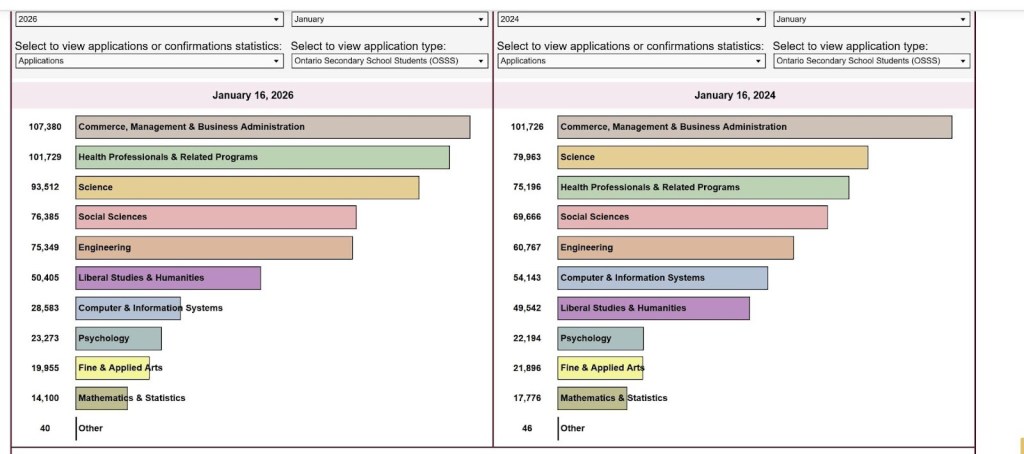
“Faculty of Computing” or “College of Computing”? Despite declining enrolments across the computing and information sector (see chart below), the Provost and the Director of the School of Computing appear to want to separate the School from the Faculty of Arts and Science. Do they intend to turn the School of Computing into a college (whatever that is) or a Faculty of Computing with direct reporting to the Provost and its own budget?
Numerous sources have told QCAA that there will be a Notice of Motion on this matter at the April Senate meeting for a vote at the May Senate meeting. This suggests that FAS Faculty Board will be bypassed, as will other bodies, processes, and consultations considered necessary by Senate itself. These include: processes associated with SCADP–the Senate Committee on Academic Development and Procedures– which is mandated to formulate and recommend to the Senate principles, policies, and priorities for the academic development of the University; and QUQAP (Queen’s Quality Assurance Program). The purpose of QUQAP is “to ensure continued high quality for both existing and new undergraduate, graduate and professional programs at Queen’s… QUQAP provides the framework for approval of new academic programs, major modifications to programs and regular reviews of existing programs.”
Have the faculty members of the School of Computing been provided with details on governance and budgeting will operate? So far, it appears no budget modeling has been presented and no assessment of the impact on academic plans currently established across departments in Arts and Science.
It is also possible that this move violates the terms of the rollover agreement with QUFA.
Given all this uncertainty, it is more important than ever that members of the community become informed about the budget model process, the leadership of Arts and Science, and the future of the School of Computing.
The hybrid Town Hall to share and discuss a new vision for Computing was set by Interim Dean Lemieux before his departure. It will take place in Ellis Auditorium, on April 8th, from 12:30-2:00 pm. Registration for in-person attendance is required. To register for the Zoom link, click here.
 Queen's Coalition Against Austerity