
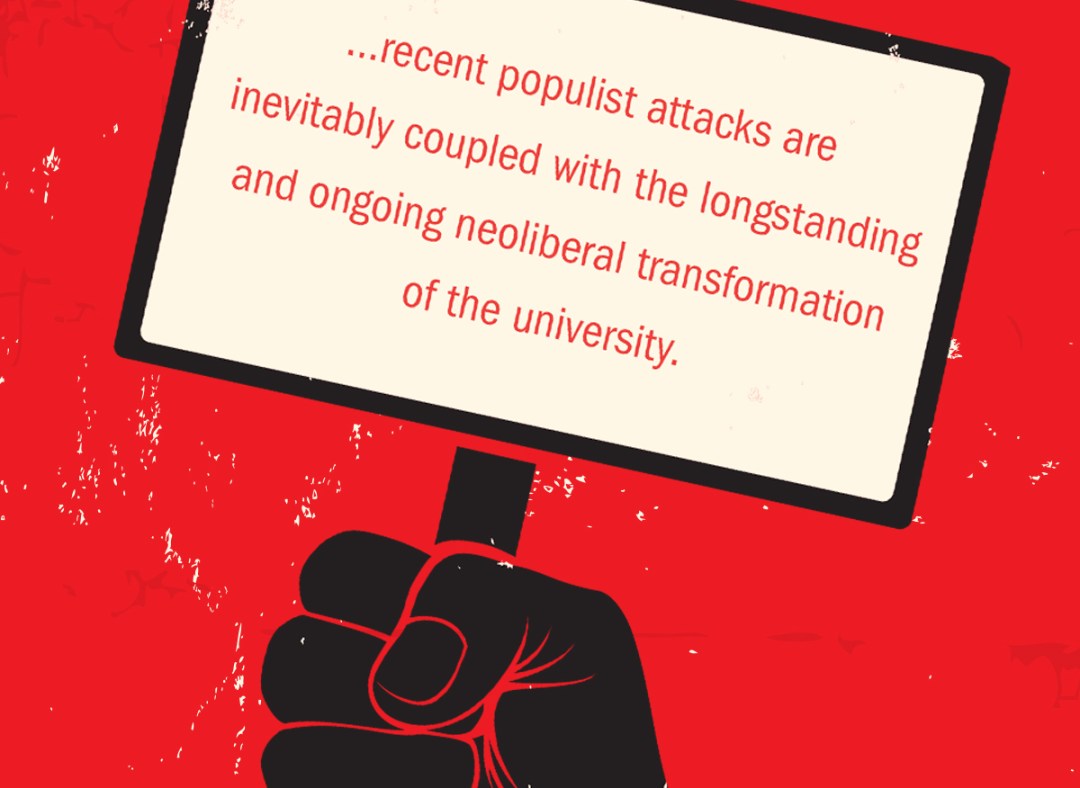
As we continue to reel from the recent provincial election in Ontario and look ahead to the influence of Pierre Poilievre at the federal level, we are increasingly concerned about how neoliberalism and privatization continue to actively dismantle public institutions, including post-secondary education. Doug Ford’s re-election grants his government a renewed license to impose conservative values on Ontario’s post-secondary system, further entrenching performance-based funding models, expanding public-private partnerships, and pressuring institutions to align with market demands. During his first term, the Ford government implemented the Strategic Mandate Agreement 2020-2025, tying provincial university funding to performance-based outcomes, including graduate employment rates and research funding.
At Queen’s, this shift has influenced program decisions, such as expanding STEM enrolment and professional programs at the expense of the social sciences and humanities. Fields that are particularly vulnerable to program closure are those that are less obviously aligned with capitalist productivity, like the arts, humanities, and social justice fields. Values that universities should serve the public and the common good, hard-won by post-WWII student movements, are ever more being replaced by mercenary labour market orientation; ironically, by precisely the very same generation that reaped the most benefits from the public university. At the governance level, we are seeing the erosion of the bicameral system of governance, where authority has been traditionally balanced between the Senate and the Board of Trustees. Decision-making powers are increasingly concentrated within the Board of Trustees, now dominated by business leaders, whose profit-oriented logics have overtaken collegial governance and academic priorities. As a result, administrators and consultants are able to bypass collegial governance bodies to reshape Queen’s even more into a competitive, efficiency-driven enterprise where students become consumers, and knowledge becomes a commodity. Curricula are increasingly shaped to serve market needs, emphasizing STEM, business, and applied skills while sidelining critical humanities and social sciences. Collaborations with industry dictate research agendas that promise commercialization, reinforce corporate values over academic freedom, and depart from the university’s professed values of critical inquiry, public service, and equity. The involvement of the international consulting firm Nous Group exemplifies these neoliberal shifts. Focused on efficiency and competitiveness, Nous has no understanding of Queen’s history and purpose as a space for democratic learning. Through initiatives like the Queen’s Renew Project, their ‘data-driven’ approach (based on capitalist metrics) risks hollowing out Queen’s function as a space for democratic learning, transforming it instead into an institution focused on rankings, returns, and capital. By prioritizing (and tying funds to) disciplines with seemingly clear economic outcomes, the university further aligns itself with Conservatives’ neoliberal interest in measurable returns on public investment at the expense of curiosity, critical inquiry, critiques of dominant narratives, and deep engagement with social, political, and ethical issues.
The broader trend of privatization and market logic infiltrating the public education sector has been going on for some 30 years at Western universities1, and Queen’s has been no exception. More than twenty years ago, the Government Issues Committee of the Queen’s Alma Mater Society (AMS) submitted a white paper to Senate on corporate involvement at Queen’s, and warned the university community of the threat to public education posed by the increasing dependency on private investment. The paper raised concerns about the influence of private interests on academic integrity and institutional missions, and emphasized the need for checks and balances to ensure that corporate involvement does not compromise the university’s core values of academic freedom and intellectual development, causing mission drift. While senior leadership may claim that checks and balances are in place to curb corporate dependency and influence, vocal criticism around the lack of transparency and disclosure related to corporate funding, unethical investments (e.g., in companies profiting from illegal occupation and apartheid and the fossil fuel industry), and the increased dependency on donations and investment income to sustain core operations suggest evidence to the contrary.
Despite this longer history of neoliberalizing higher education, what is currently happening at Queen’s and universities elsewhere feels like a watershed moment in the context of larger ongoing political transformations. As the winds of Poilievre’s pre-election rhetoric continue to billow across the post-secondary sector, calling to “defund gatekeepers,” slash regulation, shrink public services, and “crack down on ‘woke ideology’”, it is hard not to draw comparisons with the current authoritarian transformation of higher education in the US and speculate about what may be waiting for us. For universities like Queen’s, Poilievre’s flavour of right-wing populism would translate into even further corporatization, an assault on academic freedom, and a narrowing of educational priorities to fit economic outcomes. The powerful conjuncture of the two political projects that most forcefully shape our present – neoliberalism and far-right populism – suggests that the transformation of higher education may well be about more than the familiar neoliberal project, but about the remoulding of higher education in the service of right-wing and authoritarian politics. Neoliberalism has prepared the ground for these transformations: the neoliberalization of higher education in Canada has been so successful that the very idea of a public university, in the service of society, free to anyone, without tuition fees, has become unthinkable – even though, of course, such models of higher education exist in many places in the world. In this context, it has become all too easy for austerity and other neoliberal principles to be instrumentalized for the Conservative far-right agenda of imposing a more overtly ideological framework onto higher education. By baiting post-secondary institutions with funding tied to conservative social and political goals, the lines between education and corporate interests are further blurred, and universities are pressured to align with a right-wing social, geopolitical, and economic agenda.
The conservative wholesale redefinition of what a university is supposed to be demands resistance from within, through faculty governance, union pressures, community resistance, cross-campus organizing, and student organizing. When protected from political interference and market pressures, universities can serve as incubators of democratic engagement, social justice, and cultural transformation. We must prevent further erosion of the university’s relative autonomy from corporate and political interests and widen the space for dissent, critique, and radical thought. We can protect the university from being ideologically co-opted into supporting a broader right-wing sociopolitical project. To do so, we must promote collectivity over individualism, normalize activism, and continue to encourage radical critique (in response to demands for ‘civility’ and attempts to characterize resistance as something to be feared and policed). And we can continue to be outspoken in our rejection of research, hiring, partnerships, and investment aligned with corporate interests, economic nationalism, resource extraction, genocide, and global competitiveness discourses.
We must remain diligent. The democratic, liberatory, and justice-oriented potential of the public university is at stake. In the wake of Ontario’s election and with a federal one approaching, it’s clear that governments have a strategic interest in eroding public institutions. But we are not powerless. Students, staff, and faculty are not passive ‘stakeholders’ – we ARE the university. We have the power and responsibility to disrupt privatization, reject austerity, and actively remake this institution as a space of care, justice, and collective liberation. Our future doesn’t lie in waiting for the right leaders—it lies in organizing with each other, building solidarity across movements, and defending education as a public good worth fighting for.
- See e.g., Berman, Elizabeth (2012): Creating the Market University: How Academic Science Became an Economic Engine: Princeton University Press; Mirowski, Philip (2011): Science-mart. Privatizing American science. Cambridge: Harvard University Press; Münch, Richard (2014): Academic capitalism. Universities in the global struggle for excellence. New York: Routledge; Slaughter, Sheila; Rhoades, Gary (2004): Academic Capitalism and the New Economy. Markets, State, and Higher Education. Baltimore, Md: Johns Hopkins University Press. ↩︎
 Queen's Coalition Against Austerity