
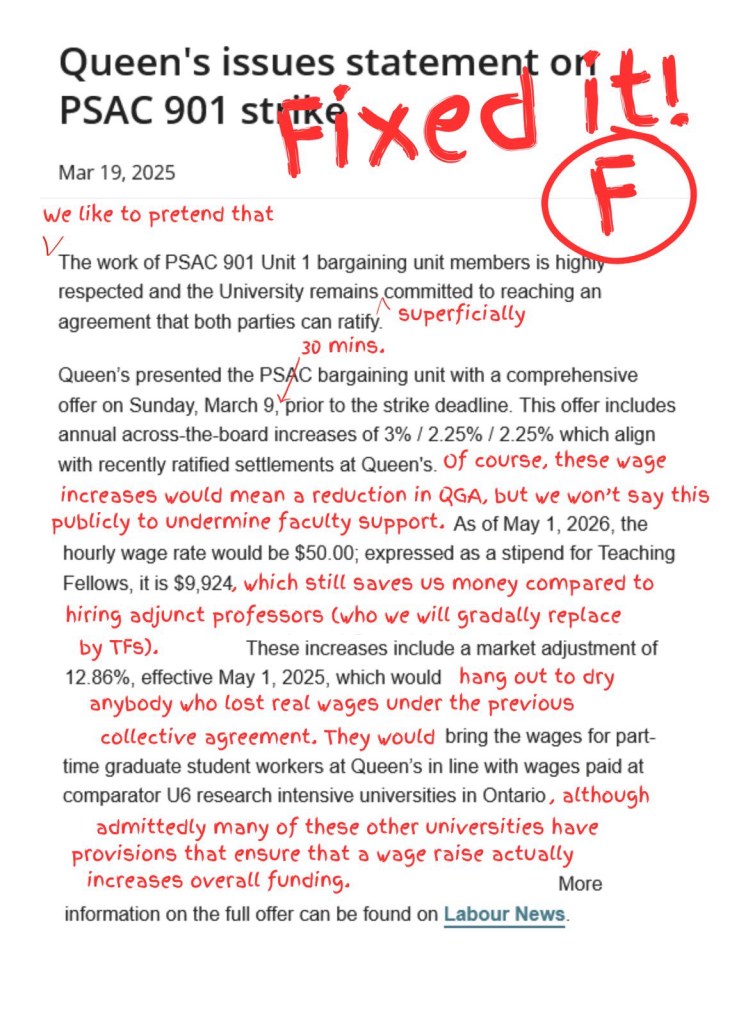
Queen’s is mustering staff, resources, and huge institutional email lists to try to shape campus narratives about the strike. Our version of the story is somewhat different. Today we are posting two items to help set the record straight. Scroll down to see a graded version of the university’s March 19th statement on the strike.
FICTION: The ball is in PSAC’s court. PSAC is the party holding up negotiations. PSAC chose not to respond and instead elected to strike.
FACT: A strike is a response. Unions are forced to go on strike when faced with inadequate offers. The administration’s offer was so bad that nothing meaningful was left to negotiate. Watch the PSAC bargaining team explain the administration’s last offer (tabled 30 minutes before the strike deadline!) and their reasons for rejecting it. As the PSAC bargaining team explains: “We understand that negotiations require movement on both sides; however, a ‘no’ response precludes any possibility of finding a way forward.” In other words, bargaining means meeting somewhere in the middle, and the strike happened because the university was unwilling to make any movement on key issues, in some cases failing to offer any response at all. It would not make sense for PSAC to revise demands to which they have received no response – they can’t, as they said, bargain with themselves. The administration, on the other hand, can return to the table with a better offer at any time.
FICTION: The administration made an offer since the strike began; it’s PSAC who is holding up bargaining.
FACT: This is false. QCAA has verified with the PSAC bargaining team that the administration has not made any revised offer since the strike began.
FICTION: All undergraduate students will receive grades and will be able to graduate on time. A CR (credit standing) grade won’t affect students’ GPAs and instructors can assign them as a way to manage grade submission requirements.
FACT: The administration is trying to force instructors and heads to give grades on unassessed work. It appears that their strategy is to pressure instructors to scab (by reweighting assignments, switching to multiple-choice exams, etc.) and, in courses where there are no scabs to do this work, assigning CR grades, which simply denote that a student took the course. By contrast, and in fairness to students, instructors would prefer for all completed coursework to be marked before assigning grades. However, unless the administration gets back to the bargaining table soon, grade submission and graduation may have to be delayed. Unfortunately, the information being distributed by the admin conflicts with official grade regulations. An instructor cannot assign a CR (only deans can), and when students do receive a CR, it is not entirely accurate to say it won’t impact their cumulative GPA. It can affect students’ GPAs in various ways, especially for those in upper years working to raise their GPAs or who returned for a 5th year of studies for that reason. It can also affect graduate school admissions since high marks in relevant coursework are considered important for acceptance to most competitive programs. It is also unclear that CRs can be assigned at all in cases where there is outstanding work to be marked because the prerequisite for a CR is a passing grade, which cannot be assigned unless all work has been graded. Thus, students may have to receive a grade deferral (GD), which would particularly impact students looking to graduate this year. In summary, the administration’s claims that all students will receive grades and will be able to graduate are questionable.
FICTION: PSAC members make a high hourly wage, so they should not complain about poverty wages.
FACT: TA, RA, or TF wages comprise just a portion of funding for graduate students who are limited by Ontario law in the number of hours they may work while studying. Therefore, they also rely on funding from the provincial government (Queen’s Graduate Award, or QGA). If wages go up, it is likely that their grant money goes down, so for most graduate students, an increase in wages does little or nothing to increase their overall funding package. Thus, while the hourly wage may seem high, their overall funding packages often fall below the poverty line (the poverty line is $27,631 in Ontario, while minimum funding packages are currently $23,000 for PhDs before tuition).
FICTION: Graduate student workers only work part-time so why are they asking for full-time salaries?
FACT: This is misleading. Like faculty, graduate student workers work full-time as researchers and educators. However, while faculty’s research is paid through wages, graduate student workers’ research is paid through provincial and other grants. This creates the false impression that they are part-time workers when, in reality, they work full-time just like faculty. The bottom line is that research is labor, too, and that labor must be compensated adequately.
FICTION: The administration offered a reasonable adjustment to inflation so PSAC members are unreasonable to refuse the deal.
FACT: As PSAC 901 explained, the union is asking for a 3% raise applied retroactively for the 2024-2025 period, due to the impact of Bill 124. In addition, PSAC901 is requesting future raises to address rising living costs: 3.25% for 2025-2026 and 3.50% for 2026-2027. These demands align with inflation rates. However, the administration has proposed only a 2.25% increase for both 2025-2026 and 2026-202, which is below the 2.6% inflation rate reported in February 2025. Moreover, the PSAC collective agreement expired on April 30, 2024, meaning that anyone currently on strike would not benefit from these increases. If PSAC accepted this offer, it would mean no improvement in their current situation, leaving issues like food and housing insecurity unresolved. This is not fair bargaining.
FICTION: PSAC is negotiating funding issues that aren’t covered by their collective agreement.
FACT: Other TA unions have successfully negotiated provisions to ensure increases to TA/RA wages also mean an increase in overall funding. For example, at U of T, CUPE 3902 negotiated a provision that only 50% of a graduate student’s base funding can come from TA or RA work. This means that when wages go up, U of T has to match those increases with non-employment funding. Thus, it is entirely possible to negotiate what PSAC calls the “funding to labor ratio” in their collective agreement.
FICTION: Housing isn’t something to be negotiated in a collective agreement.
FACT: Queen’s is a landlord and owns and rents out housing to graduate students, many of whom are international students and many of whom have families. Compare Queen’s proposal of wage increases of only 3% / 2.25% / 2.25% with its decision to raise rents in graduate student housing by 10.5% this year–not only would any wage increases be rendered meaningless by lower QGAs or fewer TA hours, a substantial portion of workers’ remaining funding package would be clawed by Queen’s through astronomical rent increases.
FICTION: Why is PSAC asking for a childcare fund? Don’t PSAC members get free childcare through Queen’s daycare?
FACT: Queen’s graduate students do not get free daycare at the Queen’s Day Care Centre. PSAC is asking the administration to set aside 55k per year to distribute among their members to subsidize childcare expenses. This would be capped at 2k per member and year – a fraction of the yearly cost of childcare. The university’s response was to include childcare subsidies in their lump sum payment which would work out to $23 per year per member, which would cover exactly 1 day of childcare at the Queen’s Day Care Center. A 55k/year pot is a reasonable ask. Some other universities provide substantially more to their graduate student workers: For example, York agreed to set aside $110K for daycare subsidies.
FICTION: The PSAC request for a yearly payment of $250,000 to support mental health and psychological safety is unreasonable.
FACT: The claim that PSAC requested a $250,000 lump sum payment is misleading. In fact, PSAC requested an annual payment of $250,000 to support the mental health, well-being, and other essential needs of employees, as explained in their live bargaining tracker. This request reflects the need for adequate support, similar to what institutions like Western University already provide. However, the employer offered a lump sum payment of $140,000, which was rejected by the union. When broken down, this offer amounts to just $23 per member per year, highlighting its insufficiency. The union’s request for a yearly payment of $250,000 is not only reasonable but necessary to address the significant hardships faced by members due to inadequate funding packages.

If you hear about other misconceptions, please inform QCCA through the gossip box, and we will circulate them.
 Queen's Coalition Against Austerity